
Why Google rewrites your title and description
What a good title and description look like, the specific problems that make Google replace them, and the template mistake that causes most of them.
By Metryn · Updated 16 October 2026 · 4 min read
Short answer: write one specific title and one honest description per page. Google may still rewrite either, and most rewrites happen because the original was empty, repeated or inaccurate.
Titles
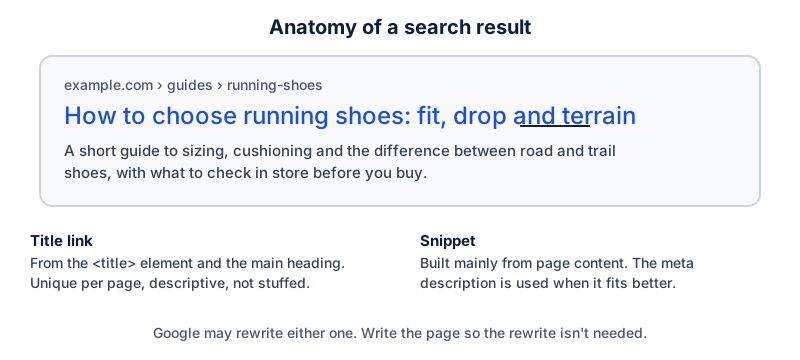
Google asks that every page has a <title> element, and that it's descriptive and concise. It names vague labels like "Home" or "Profile" as weak, and says repeating the same words or stuffing keywords doesn't help users and can look spammy. Brand the title briefly, at the start or end, separated by a hyphen, colon or pipe.
Google builds the title link from several sources: the <title>, the visible main title, headings and even anchor text. It lists the situations where it's likely to change what you wrote.
| Problem on your page | What Google may do |
|---|---|
Half-empty title, such as | Site name | Use header text instead |
| Outdated date in the title that doesn't match the page | Replace it with a more accurate one |
| Title doesn't reflect the content | Build one from other parts of the page |
| A group of pages sharing the same title | Add distinguishing details such as a season number |
| Several large headings that look equally important | Pick one itself |
| Site name repeated when it's already shown | Drop the duplicate |
Meta descriptions
Google says it may use the meta description when it describes the page better than the page's own text, and that it isn't always used. The advice is to make each one unique, summarize the page accurately, and add details a person would use to decide, like price, author or date. There's no length limit, though display is cut to fit the device width. Programmatic descriptions are fine on large sites if they stay readable and varied.
The one fix that matters most
Look for pages sharing a title. On stores and blogs it's usually a template filling in the same string for every product, category or tag page. Fixing the template once fixes hundreds of pages.
Questions people ask
How long should a title be?
Google's documentation doesn't give a fixed number. It says overly long titles are truncated in results, typically to fit the device width.
Do I need a meta description on every page?
Google recommends unique descriptions, prioritizing key pages like the homepage and popular URLs if time is short. It also says it may not use your description at all, if it judges the page text to describe the page better.
Is it OK to generate descriptions with a template?
Google says programmatic descriptions are acceptable on large sites as long as they stay human-readable and varied. Fifty thousand identical descriptions don't meet that.
Should my title and my H1 match?
They don't have to be identical. Google says it builds the title link from the <title>, the visible main title and other signals, and recommends making the main title visually distinct, for example in the first visible <h1>. A page where they say very different things invites a rewrite.
What to do this week
- Export your page titles with a crawler or from your CMS, and sort them to find duplicates.
- Fix the template for the biggest duplicate group first.
- Rewrite the homepage and your five most important pages by hand.
- Make sure there's one clear main heading on each page.
Check your own site
Paste your address below. The free scan looks at robots.txt, your sitemap, access for the main AI crawlers and structured data, and shows what it found in seconds. It tells you what a machine can fetch and read. It doesn't predict rankings or citations.
Sources
- Google Search Central: Influencing your title links: https://developers.google.com/search/docs/appearance/title-link
- Google Search Central: Control your snippets: https://developers.google.com/search/docs/appearance/snippet
- Google Search Central: Image SEO best practices: https://developers.google.com/search/docs/appearance/google-images
Keep reading
Problems and how to fix them
Why isn't my site showing in ChatGPT or AI search?Problems and how to fix them
robots.txt Disallow vs noindex: which to useProblems and how to fix them
"Discovered" vs "Crawled", not indexed: what to do
Want to check one file yourself? Try the free AI crawler robots.txt checker or the llms.txt validator, or read how the score is built.