
What makes an online store look trustworthy
The ordinary signs of a real business, from an About page and returns policy to Organization markup, and why they matter more as it gets easier to open a store.
By Metryn · Updated 16 October 2026 · 5 min read
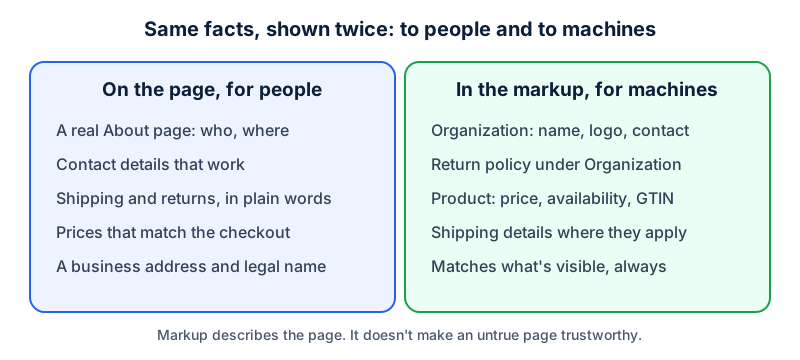
Anyone can open an online store in an afternoon, and shoppers know it. That's why the ordinary signs of a real business matter more than they used to. They're also exactly the things a machine can read, so the same work helps both audiences.
A scope note first
Nothing here detects fraud, and no markup makes an untrue store trustworthy. Google's structured data rules are explicit: markup has to be a true representation of the page, and markup that breaks the guidelines can lead to a manual action. What follows is how an honest store makes its honesty easy to see.
What people look for
- Who's behind it. Google's own content self-check asks whether a page shows why readers should trust it, such as clear sourcing, author background or an About page. A store is no different: a real name, a place, and ideally a face or a story.
- A way to reach you that works. An email you answer, a business address, a phone number if you take calls.
- Shipping and returns in plain language, before checkout. Not buried in a PDF.
- Prices and stock that match what happens at the cart. Mismatches are the quickest way to lose a buyer, and a reason a listing may not show.
- Policies you actually follow. If you copy a returns policy from somewhere, make sure it describes your operation.
What machines can read
Google's ecommerce documentation points to Organization markup for your business as a whole: logo, contact information, business identifiers, and return policies. For policies it recommends a site-wide return policy under Organization, with offer-level shipping and return details overriding it where they differ. On product pages, merchant listings need the product name, an image that's crawlable, and a price above zero with a currency, and the merchant has to be the seller.
{
  "@context": "https://schema.org",
  "@type": "Organization",
  "name": "Your Store Ltd",
  "url": "https://example.com/",
  "logo": "https://example.com/logo.png",
  "contactPoint": {
    "@type": "ContactPoint",
    "contactType": "customer support",
    "email": "support@example.com"
  },
  "hasMerchantReturnPolicy": {
    "@type": "MerchantReturnPolicy",
    "applicableCountry": "PT",
    "returnPolicyCategory": "https://schema.org/MerchantReturnFiniteReturnWindow",
    "merchantReturnDays": 14,
    "returnMethod": "https://schema.org/ReturnByMail"
  }
}
Replace every value with your real ones, and keep each in step with what the pages say. If your page says 30 days and your markup says 14, you've created exactly the mismatch Google warns about.
Things that make a store look the opposite
- Product descriptions copied from the supplier, which Google's spam policies describe as a hallmark of thin affiliation and scraping.
- Thousands of near-identical pages generated in bulk, which the scaled content and doorway policies describe.
- No About page, no address, or a contact form that never answers.
- Reviews or ratings you can't back up. Marking up reviews that aren't on the page isn't allowed.
None of this is a ranking trick. It's an inventory of what an honest operator can show and a careless or dishonest one usually can't be bothered to.
Questions people ask
Do reviews help?
Genuine reviews help shoppers. Google's structured data guidelines say review markup has to be representative of what's on the page, and that if a page has several reviews, all visible reviews should be marked up. Inventing them is not an option.
Do I need to show my business address?
The documentation doesn't require it for every store. For shoppers, a real address is a strong sign of a real business, and Organization markup has fields for contact information and business identifiers.
Is the return policy markup worth the effort?
Google recommends a site-wide return policy under Organization, and says return and shipping information are among the details merchant listings can show. If your policy is clear in the page, adding it once is cheap.
What if I'm brand new and have nothing yet?
Show what you do have: who you are, why you started, how to reach you and what happens if something goes wrong. A new store with honest basics is easier to believe than one with borrowed praise.
What to do this week
- Write or rewrite your About page with a real name and place.
- Put shipping and returns where a shopper sees them before the cart.
- Check prices and stock on a product page against the cart.
- Add
Organizationmarkup with contact details and return policy.
Check your own site
Paste your address below. The free scan looks at robots.txt, your sitemap, access for the main AI crawlers and structured data, and shows what it found in seconds. It tells you what a machine can fetch and read. It doesn't predict rankings or citations.
Sources
- Google Search Central: Creating helpful, reliable, people-first content: https://developers.google.com/search/docs/fundamentals/creating-helpful-content
- Google Search Central: Structured data for ecommerce sites: https://developers.google.com/search/docs/specialty/ecommerce/include-structured-data-relevant-to-ecommerce
- Google Search Central: Merchant listing structured data: https://developers.google.com/search/docs/appearance/structured-data/merchant-listing
- Google Search Central: General structured data guidelines: https://developers.google.com/search/docs/appearance/structured-data/sd-policies
- Google Search Central: Spam policies: https://developers.google.com/search/docs/essentials/spam-policies
Keep reading
Guides for stores and SaaS
AI search readiness for a SaaS site: where to startGuides for stores and SaaS
Product pages that search and AI systems can readGuides for stores and SaaS
Dropshipping stores: supplier copy and duplicates
Running a store? See Metryn for online stores for what the scan checks and the other guides written for store owners.
Want to check one file yourself? Try the free AI crawler robots.txt checker or the llms.txt validator, or read how the score is built.